Literature review chapter
Run a scoping review your examiners can retrace
Many candidates are told to “start with a scoping review”. Done properly, it becomes a thesis chapter and often a first paper. This kit keeps the record that makes both possible.
Scoping reviews in a thesis usually fail in the same two places: a search nobody can reproduce and screening counts that were never written down. Both are impossible to reconstruct months later, when an examiner or a journal reviewer asks.
What you work through
- Confirm it should be a scoping reviewFive review types side by side, so you and your supervisor agree before any searching.
- Frame the questionWho, what and where the review covers, with its key idea pinned down before searching starts.
- Write and register the protocolTen sections, what each needs, and where scoping protocols can be registered.
- Set eligibility and source typesCriteria for each element, and the grey-literature decisions to make on purpose.
- Build the searchA concept-to-term grid, the three-stage procedure and tests to run before the full search.
- Document every searchOne record per database plus a grey-literature log that a reader could repeat.
- Run, de-duplicate and countEvery number the flow diagram needs, captured when it exists.
- Screen with a second reviewerCalibration first, then one recorded reason per excluded full text.
- Design the data-extraction formEach field linked to an objective, trialled on a handful of sources first.
- Collate and categoriseCounts by dimension and categories you have defined and checked.
- Map the evidence and the gapsAn evidence map that shows empty cells, and gap statements that stay inside the evidence.
- Report it and defend itWhat a write-up must report, and the challenges examiners typically raise about scoping reviews.
The Search, Screening & Charting workbook
The workbook that goes with the worksheets, for Excel or Google Sheets:
- Search Log — each source with the string exactly as it was run
- Flow Numbers — records found, removed and kept at each stage, reconciled automatically
- Screening Log — each decision with one exclusion reason, tallied
- Charting Form — the extracted details of each included source
- Category Matrix — tallies that feed the evidence map
- Reporting — the reporting items and what is still unaddressed
Look inside
Low-resolution, watermarked previews of four pages.
Is it for you?
- Candidates whose literature review chapter is, or will become, a scoping review.
- Supervisors and small teams who want one shared protocol and screening record.
It is not a systematic review or meta-analysis kit, and it does not reproduce the published reporting checklist - it points you to the current version and tracks your work against it.
Free to use alongside it: Free literature review readiness check.
The Scoping Review Protocol Kit — $12, one-time.
Kits for your other milestones
-
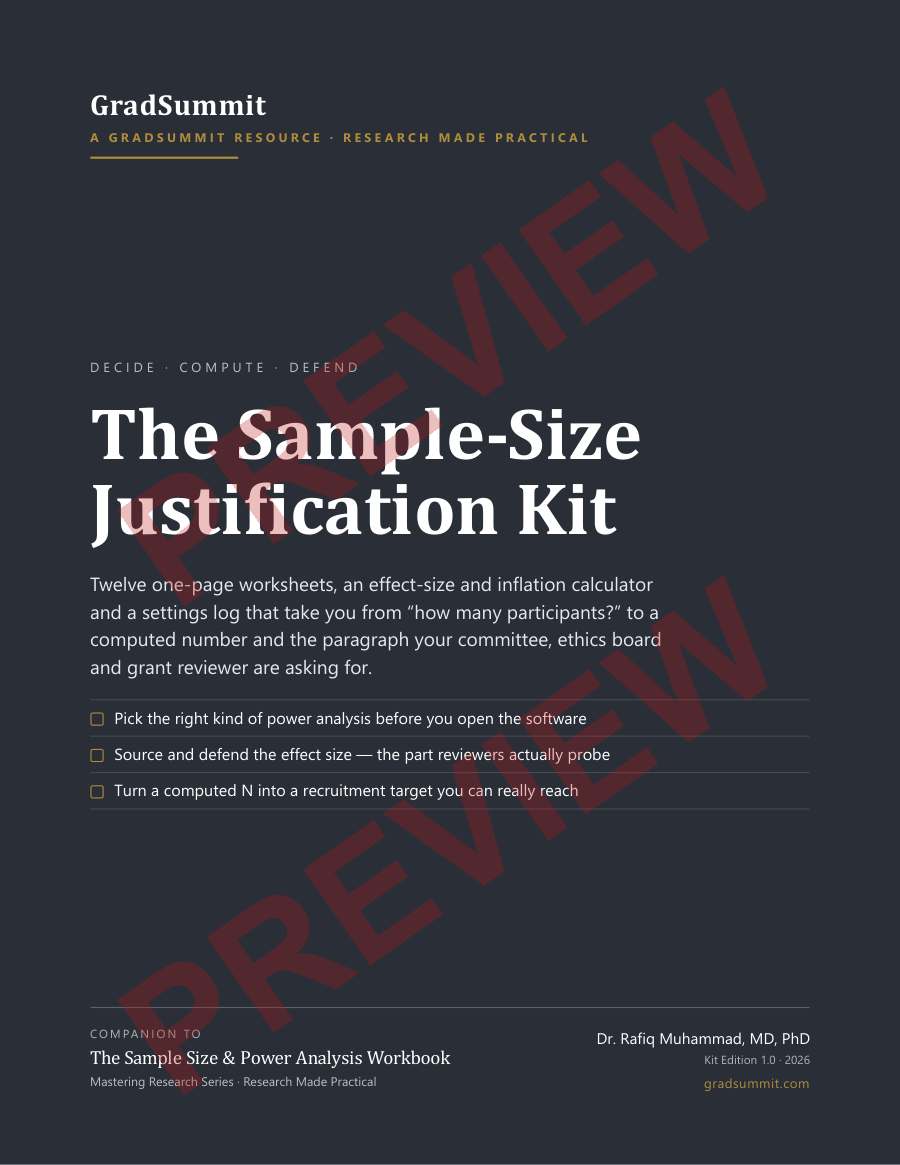 Proposal, ethics and confirmation
The Sample-Size Justification Kit
Worksheets and a calculator log for the sample-size section your committee and ethics board will question: a sourced effect size, a number and the paragraph.
$12 -
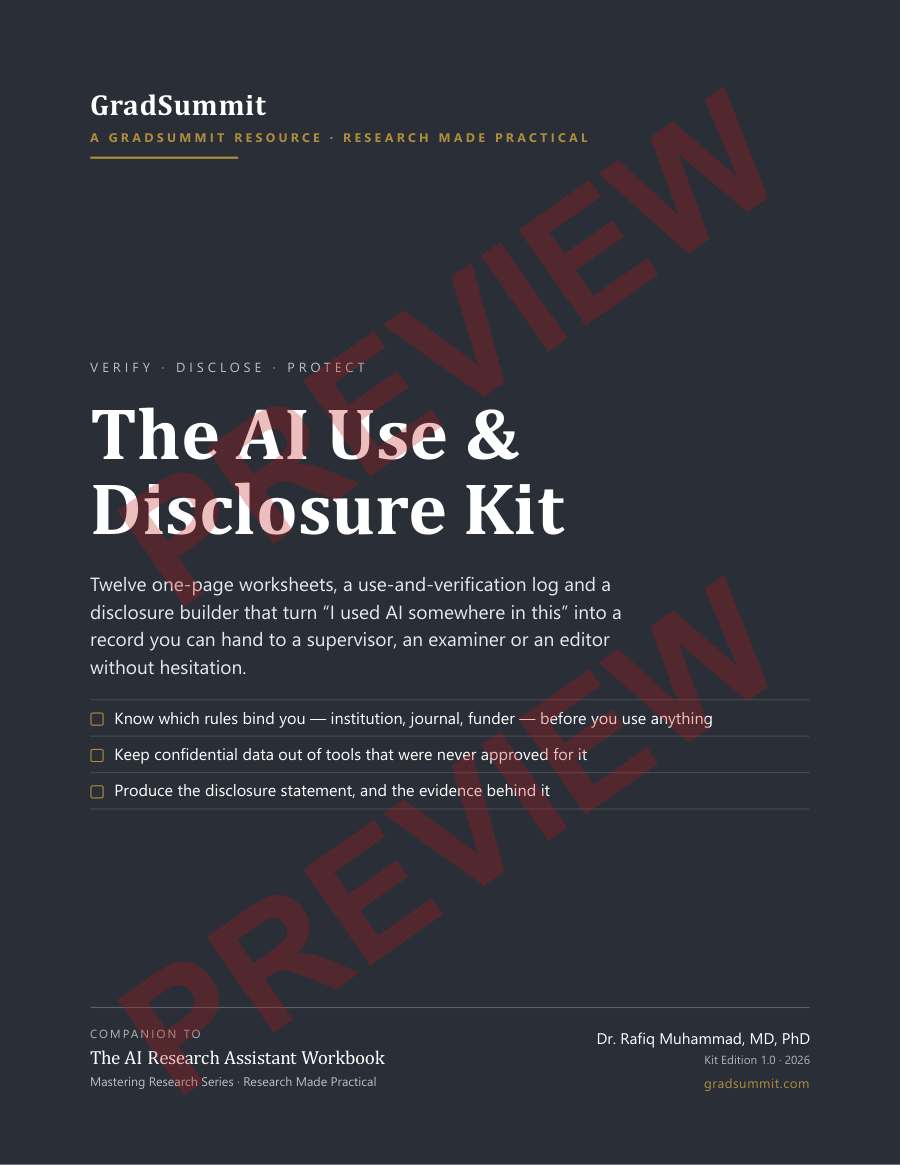 Throughout the thesis
The AI Use & Disclosure Kit
Record, verify and disclose how you used AI tools in a thesis: your institution's rules, a data gate, a verification log and a disclosure statement.
$9 -
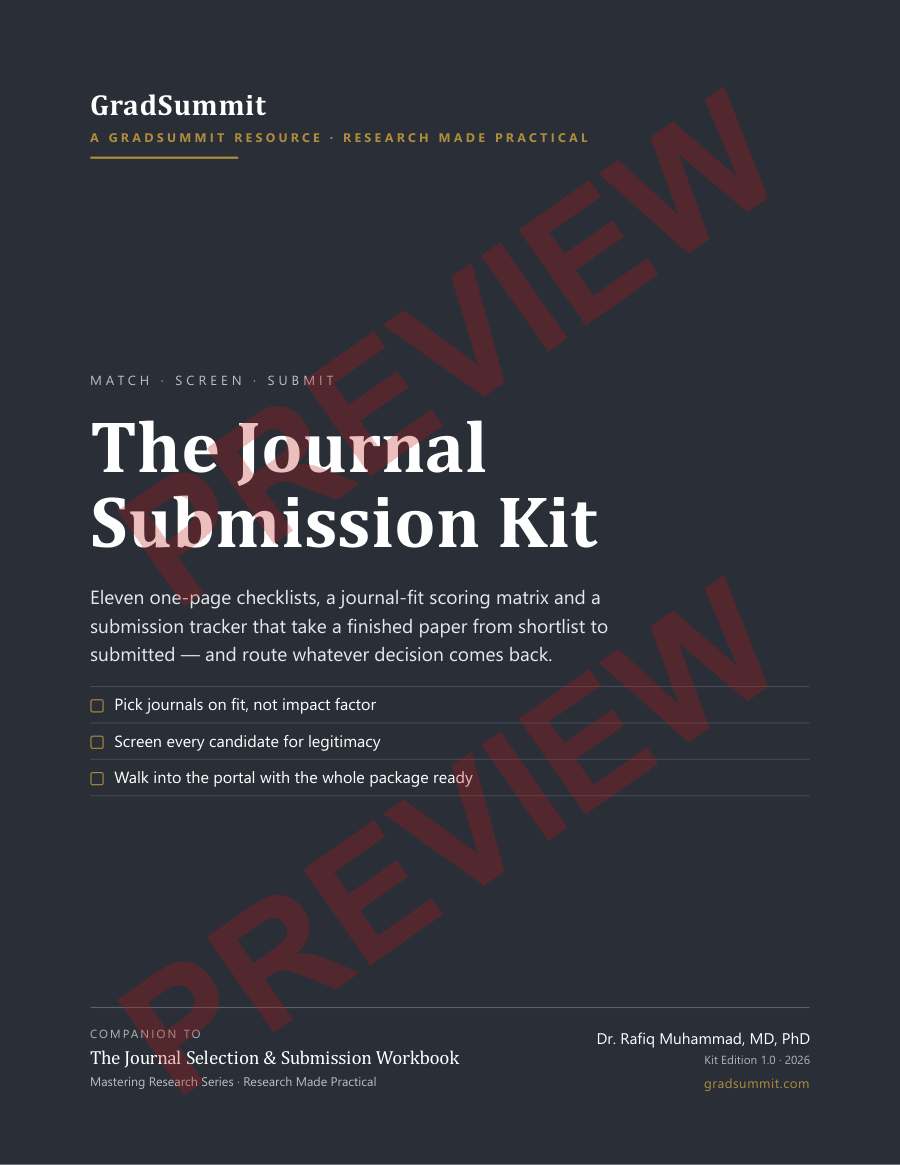 Publishing during candidature
The Journal Submission Kit
Checklists and a tracker for submitting a paper during your PhD: shortlist journals, check scope and legitimacy, build the package and track decisions.
$9 -
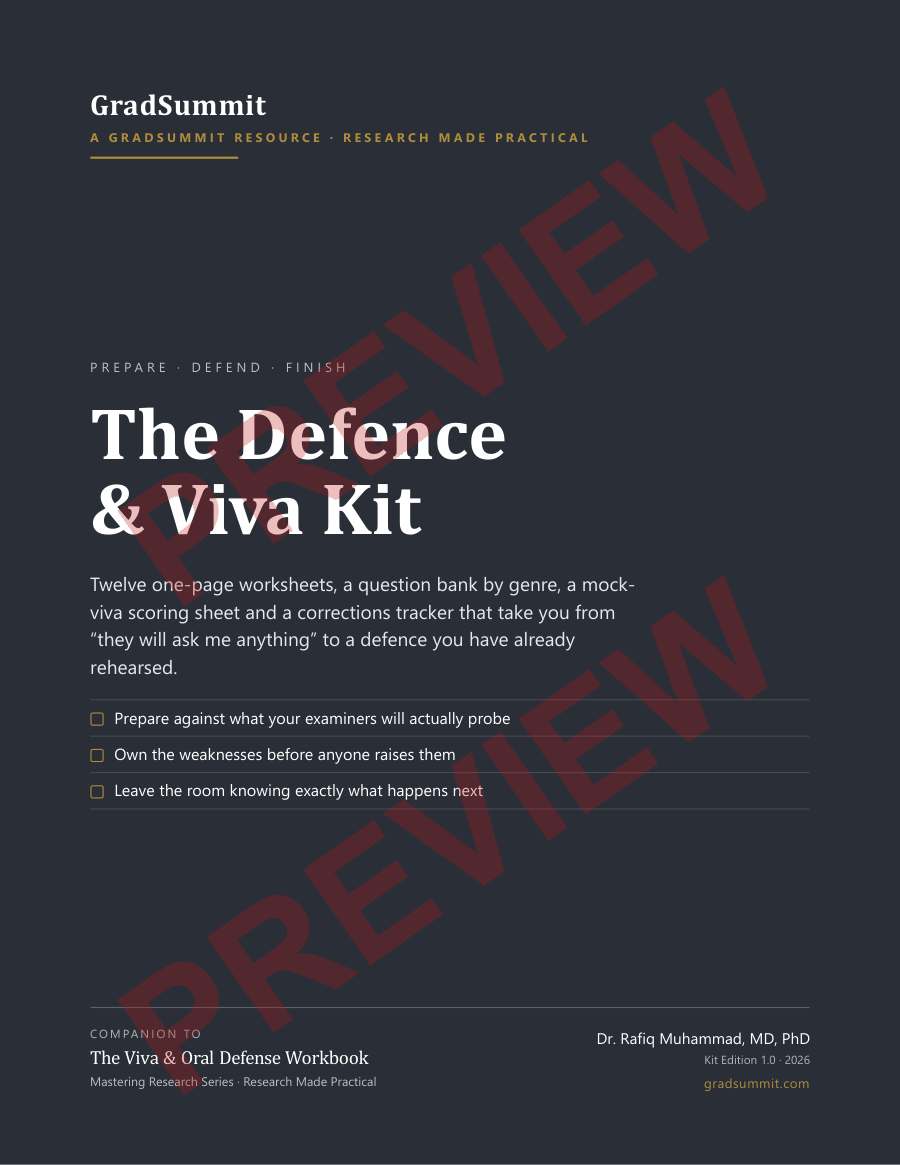 Examination
The Defence & Viva Kit
Prepare for your viva or thesis defence: a question bank by type, examiner dossiers, mock-viva scoring and a corrections tracker for after.
$15
Frequently asked questions
Can a scoping review be a thesis chapter?
Yes, and in many programmes it is the first one. The kit keeps the protocol and audit trail an examiner expects to see behind that chapter.
I am the only reviewer. Is that a problem?
Methodological guidance recommends two people screen and extract. The kit sets out a practical way to agree decisions with one - often your supervisor, on a sample - and how to describe a solo review transparently.
How is this different from a systematic review?
Scoping reviews describe the extent and nature of a body of evidence; systematic reviews answer a focused question and judge study quality. The opening worksheet settles which of the two your chapter needs.
Will it help me publish the review?
It keeps exactly what journals ask for: a registered protocol, a reproducible search, reconciled flow numbers and reasons for exclusion.
What do I get, and in what format?
One ZIP download: the kit as PDF in both US Letter and A4, and a workbook that opens in Excel or Google Sheets. Fill the PDFs in on screen or print them.
How do I get the files?
The download page opens as soon as Stripe confirms payment, and a copy of the link arrives by email. A link stays valid for two weeks and ten downloads, and a replacement can be requested below whenever you need one.
Who processes the payment?
Stripe. The receipt and download email come from the author's publishing imprint, GradSummit, which delivers the kits for this site. Your card details are never seen by us.
What if the files will not open?
Email us within two weeks of buying and we will fix it or refund you in full. A refunded purchase can no longer be downloaded.
Lost your download link?
Type the address you paid with and a new link will be sent to it.